Thursday, February 7, 2008

Red Hooded Sweatshirt?

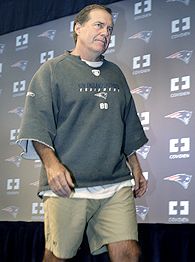
It isn't just an Adam Sandler song, dear reader. No, the headline refers to the great untold story of this past Sunday's game: New England Patriots Head Coach Bill Belichick's ill-fated decision to wear a red hooded sweatshirt to Super Bowl XLII. What's wrong with this particular choice of attire, you ask? You see, as had been endlessly documented, the Patriots were 18-0 going into the Super Bowl, a historic single-season run that had never been matched (note that the undefeated 1972 Miami Dolphins went 17-0). Throughout this seemingly unstoppable march to history, Coach Belichick wore a garment that had taken on a life of its own--a gray hooded sweatshirt with manually cut off sleeves. One might presume, given the superstitious nature of the sporting world, that a man so very close to history would not tinker with what had gotten him there. Alas, one would be wrong.

Legendarily cantankerous, Coach Belichick opted to go with the bright red number shown on the right in a move that can perhaps be construed as an overt spitting in the collective face of the Sporting Gods. Indeed, perhaps the coach's supreme confidence in what some pundits were calling potentially the Greatest Team of All Time drove him to take on superstition itself, that one almighty and unassailable power that dwells within every missed field goal and every called third strike. Instead, this decision to stick a finger in superstition's eye (a decision that will forever be ruefully lamented in that most superstitious of sports towns, Boston) was Coach Belichick's Icarus moment, his own personal Operation Barbarossa. Perhaps we can never be sure why New England's offensive line picked February 3 to forget its blocking schemes, or why its offensive coaching staff chose that day to misplace its max protect formations. What we can be sure of, however, is this: Superstition is a mere phone call away from Fate.

Monday, January 21, 2008

Doubling Down

Rarity makes life special. That is why things may be exciting to children – flying on a plane or going to the top of a skyscraper – yet bore an adult that has become accustomed to “rarities.” As in life, rarity is what makes sports worth watching. Brett Favre would not be able to capture America’s heart if every team had a “Brett Favre” - i.e. good looking (or so the ladies tell me), down-to-earth, charismatic, humble, troubled, and honest player- at quarterback. There is, however, only one Brett Favre, and that is why America loves him. Recently I was reminded of the importance of rarity, when I was fortunate enough to witness the rarest of all events: the double down on twelve.

That may be a slight exaggeration. Some things are probably rarer than doubling down on twelve: an unassisted triple play; back-to-back no hitters; or a 100 point game in the NBA. Although those events are rare, I knew each of those events could happen, since they have before, even if I never expected to witness one during my lifetime. At not point in my life, however, had it occurred to me that I might see someone double down on twelve. Forget about wondering whether I thought I would see someone do it, I never thought someone would double down on twelve. Naively, I believed that everyone – blackjack players, the dealers, their respective mothers, fathers, sisters, brothers, children, grandparents, from any nationality whatsoever– doubled down on eleven, and only eleven. Yet, at a Casino, recently, a friend of mine clearly stated to the dealer “double down,” with an illustrious face card and two showing. Not believing what she had heard, the player to his left attempted to grab the chips off the table before the dealer had even realized that he had placed another bet. Exclaiming, "he did not mean it!" Oddly enough, that’s not the type of thing a dealer misses, and he politely explained to the woman that the chips would remain right on the table. (That's actually what his eyes said, since he spoke Portugese, we could not understand a thing he said.) Fortunately, fate is just, and has a sense of humor, because the double downer received a two, and lost to the dealer. (The story would not be remotely as funny had he miraculously comeback to win, despite that mental error of Chris Webber-esque proportions.)

Oh, for those of you who ignore the "don't try this at home" warning, please, PLEASE, do not attempt to explain away the event to your friends by saying "I never claimed to be a Blackjack expert." If you had an infinite number of monkeys, with an infinite number of typewriters, one of them would write Shakespeare. None of them, however, would double down on twelve.

Friday, December 14, 2007

Somewhere, Randy Jones Gets Loose

The Padres have indeed signed Glendon Rusch. Along with their earlier Shawn Estes signing, the Pads have now cornered the market on comebacking lefty starters who were never any good in the first place. Fantastic.

Padres General Manager Kevin Towers is rapidly forfeiting his reputation as a savvy baseball executive; we here at UMVPs are delighted to have more fodder.

Sunday, December 9, 2007

Resurrecting the Lousy

An incredibly disturbing trend is sweeping the National League this offseason: NL teams are highly interested in the comeback attempts of left-handed starting pitchers who were never any good. The southpaw hurlers at the forefront of this latest wave of front office insanity are the esteemed Shawn Estes, a lifetime National Leaguer sporting a career ERA 4.71; the 45 year-old Jeff Fassero, sporting ERAs of 5.35, 5.68, 5.46, 4.06, and 7.80 over his last five seasons; and, perhaps most stupefying of all, Glendon Rusch, he of the 5.01 career ERA.

Your skepticism is warranted, dear reader. Surely these well-compensated baseball executives can dig up some 23 year-old minor leaguer who can post similar numbers to what these washed-up never-wases would bring to the table, right? Yes, this would be the reasonable alternative. Unfortunately, Mr. Estes has already signed with the Padres, Mr. Fassero is being brought in to pitch for Mets scouts, and Mr. Rusch, apparently the most popular of them all, is drawing interest from the Reds, Astros, Cardinals, and, in what can only be described as an orgy of misguided nostalgia, the Padres along with Mr. Estes.

Well, fine, then perhaps these are crafty veterans possessing some smoke-and-mirrors knowhow developed from years of finding ways to get hitters out? No, this is very much not the case. In his 13 years in the big leagues, Mr. Estes has posted a sub-4.00 ERA only twice: in 1996 and 1997. That's right, a full decade. Additionally, although 3.60 in 1996 and 3.18 in 1997 seem downright adequate on the surface, his WHIP for those seasons was a horrendous 1.46 and 1.30, respectively, and he had the benefit of playing home games in that most brutally hitter-unfriendly of ballparks, the old Candlestick Park. Indeed, since 1997, he has lived in the high-4.00 to high-5.00 range. Mr. Fassero last posted a sub-4.00 ERA "only" six seasons ago in 2001, but this was done in a purely relief role; further, as noted above, he has been unacceptably horrid ever since, and his 25 starts in that span have been nothing short of an unmitigated disaster. Mr. Rusch, in his ten-year career, has posted a sub-4.00 ERA once, and that was in 16 spot starts and 16 relief appearances for the Cubs in 2004. But, again, his lifetime ERA is 5.01, and in 66.1 IP last season he posted an eye-watering 7.46 ERA.

Yes, dear reader, you are justified in throwing your hands up in disgust and considering finding out whether you too can throw a baseball left-handed.

We believe we are not alone in hoping that Shawn Estes and Glendon Rusch round out the 2008 starting rotation for a Padres team that came within a one-game playoff of reaching the postseason in 2007. We can only pray that a Randy Jones comeback is somewhere on the horizon.

Wednesday, December 5, 2007

Any Day Now, Omar

Hey, look at that, this is the inaugural post. Lucky me. Onto business!

There was much eye-rubbing and head-scratching when word came out that the Mets had dealt young outfielder Lastings Milledge for decidedly older outfielder Ryan Church and offensive sinkhole/catcher Brian Schneider. What purpose did that serve for the Mets, we all wondered. Why trade away a promising young talent with significant upside for a fourth outfielder/platoon player already in his unremarkable prime (and getting no better) and a defensive-minded backstop with a weak stick whose overall skills have already begun to decline? Further, why take on significantly more salary while doing this? Surely, we thought, Mets General Manager Omar Minaya was obtaining these two rather pedestrian pieces because they were to be included in some future deal for the front line starting pitcher Mets fans so desperately crave.

Well, the Winter Meetings near their end (indeed, some GMs have already gone home), but still no new ace for the Amazins. What's worse, all reports out of Nashville indicate that the Mets simply lack the available talent to come through with a winning offer for pitchers like Johan Santana or Erik Bedard, giving little hope to fans of the team from Queens that any major deal could possibly happen before Spring Training.

Is this the end of the world? Probably not. The Mets still have a better collection of players than almost all of their National League adversaries, and there is still plenty of time to retool the mayday bullpen that no amount of Jose Reyes high-fiving could overcome down the stretch last season. Additionally, the return of a healthy Pedro Martinez and another year of maturity for John Maine and Oliver Perez probably mean that next year's starting rotation will outperform last year's even if no trade for the much-cliched "#1 starter" is made. To speak the truth, there is really no reason why the Mets shouldn't win 90+ games in 2008. So why is there a very significant collective case of indigestion going on in Orange and Blue territory?

The culprit is expectation. Rather than downplay the Mets' chances of landing an impact starting pitcher via the trade market, Mr. Minaya decided to stoke the fires of optimism in every Mets fan, declaring,
"All those guys that are being mentioned in the market, as far as trade market, we've been in contact with these guys, on a regular basis."
The common Mets fan could not help but assume that their fearless GM would never say such a thing unless he was certain a big-name arm was coming to Shea. So as Mr. Minaya's working vacation in Nashville ends and he returns empty-handed (or perhaps lighter in the hypothetical wallet for having given away a useful trading chip in Milledge), legions of faithful Wilpon customers can only groan and hope that Kevin McHale takes over a rival Major League Baseball franchise sometime soon.